
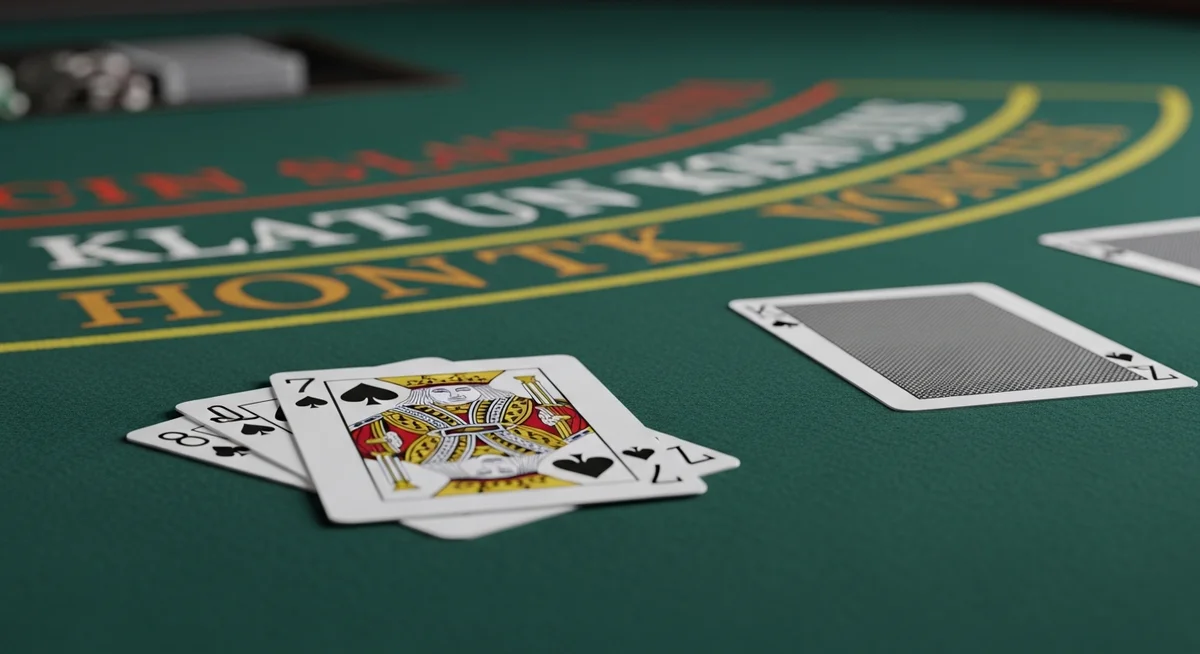
THE ESSENTIAL
Blackjack is a game of chance where players attempt to beat the dealer by forming a hand total as close to 21 as possible without exceeding it.
- The default house edge in standard blackjack is approximately 0.5% when players use perfect basic strategy.
- Every card has a specific point value, with aces counting as either 1 or 11 depending on what benefits the hand.
- Payouts for a natural blackjack traditionally stand at 3:2, though some modern tables offer a less favorable 6:5 payout.
- The legal age for participating in casino games is generally 18 or 21 depending on your local jurisdiction.
While learning how to play blackjack: rules and basics can reduce the house advantage, outcomes remain entirely random and no strategy can guarantee a winning session.
What Is the Objective of Blackjack?
Blackjack is played with 1 to 8 standard decks of 52 cards. The fundamental goal is to achieve a hand total that is higher than the dealer’s total without exceeding 21. If your hand exceeds 21, you “bust” and immediately lose your wager. You only compete against the dealer’s hand, meaning the hands of other players at the table do not affect your success.
The house holds an inherent advantage because the player must act first and loses their bet immediately if they bust. This remains true even if the dealer subsequently busts in the same round. According to reports from the UK Gambling Commission, understanding these fundamental probabilities is a cornerstone of player safety and risk awareness.
What Are the Blackjack Card Values?
To calculate your hand total, you must sum the values of your individual cards. The game uses standard point assignments that never change regardless of the casino or the variation you play.
- Cards from 2 through 10 are worth their exact face value.
- Face cards, which include the Jack, Queen, and King, are worth 10 points each.
- Aces are unique because they can be valued at either 1 or 11, depending on which total benefits your hand.
How Does the Step-by-Step Game Flow Work?
The game follows a strict, sequential order of play to ensure fairness and transparency. Every participant at the table must complete their actions before the dealer reveals their hand.
- Placing Bets: Players place their chips in the designated betting area before any cards are dealt.
- The Deal: The dealer distributes two cards face-up to each player, and two cards to themselves, with one face-up and one face-down.
- Player Decisions: Starting from the left, players choose to hit, stand, double down, or split based on their cards and the dealer’s visible card.
- Dealer’s Turn: Once all players complete their turns, the dealer reveals their face-down card and must play according to strict casino rules.
- Payouts and Round Resolution: Hands are compared, winning bets are paid out, losing bets are collected, and the dealer prepares for the next round.
What Are the Core Blackjack Player Decisions?
During your turn, you must choose how to play your hand based on the mathematical probabilities of the remaining cards. Making the correct decisions is vital to reducing the casino’s statistical advantage.
- Hit or Stand: Taking another card or keeping your current total.
- Double Down: Doubling your wager in exchange for exactly one more card.
- Splitting Pairs: Separating matching cards into two individual hands.
- Surrender and Insurance: Defensive options that alter your stake or protect against a dealer blackjack.
Hit or Stand
Choosing to hit means asking the dealer for another card to increase your total. Choosing to stand means keeping your current total and ending your turn. Players must strike a balance to avoid busting while trying to outscore the dealer.
Double Down
To double down means placing an additional bet equal to your original wager. In return, the dealer gives you exactly one more card, and your turn ends immediately. This option is highly favorable when you hold a strong starting hand total, such as a hard 10 or 11, against a weak dealer card.
Splitting Pairs
If you are dealt two cards of the identical value, you can split them into two separate hands. This requires placing an equal second bet. You then play each hand individually, receiving at least one additional card on each new hand.
Surrender and Insurance
Some tables allow a surrender, where you forfeit half your bet to abandon a weak hand before taking any actions. Insurance is a side bet offered when the dealer’s face-up card is an Ace. Independent testing agencies like eCOGRA and regulatory bodies like the Malta Gaming Authority note that insurance has a high house edge and is mathematically disadvantageous for casual players.
How to Play Blackjack: Rules and Basics of Strategy
Basic strategy is a mathematically optimized system that dictates the best action for every possible combination of your hand and the dealer’s upcard. Using this strategy is the only reliable way to minimize the house edge to its lowest possible level of 0.5%.
| Player Hand Type | Dealer Upcard | Optimal Decision | Strategic Purpose |
|---|---|---|---|
| Hard 17 or higher | Any card | Stand | Minimizes the high risk of busting on a hit. |
| Hard 11 | 2 through 10 | Double Down | Capitalizes on a strong probability of reaching 21. |
| Pair of Aces or 8s | Any card | Split | Breaks up weak totals into two high-potential hands. |
| Hard 12 to 16 | 2 through 6 | Stand | Allows the dealer a high probability to bust. |
| Hard 12 to 16 | 7 through Ace | Hit | Protects against the dealer’s strong potential hand. |
What Is the Strategy Order of Operations?
When deciding how to play your hand, follow a structured sequence of choices. This sequence ensures you do not overlook a valuable tactical option before it is too late.
- First, ask if you should surrender: This is only possible on your first two cards.
- Second, ask if you should split: Only applicable if you hold a pair.
- Third, ask if you should double down: Check if the dealer’s card and your hand total warrant this aggressive option.
- Finally, decide to hit or stand: If none of the previous options apply, choose whether to take another card.
What Are the Key Strategy Rules for Beginners?
A few fundamental rules form the core of basic blackjack strategy. Memorizing these will help keep your mistakes to a minimum.
- Always split Aces and 8s: A pair of Aces gives you two chances at a soft 21, while a pair of 8s is a weak 16 that is better played as two separate 8s.
- Never split 10s or 5s: A pair of 10s is a highly secure 20, while a pair of 5s should be treated as a hard 10 for a potential double down.
- Stand on hard 12 through 16 against a dealer 2 through 6: The dealer is highly likely to bust when starting with these weak upcards.
- Hit hard 12 through 16 against a dealer 7 through Ace: The dealer’s chances of making a winning hand are strong, so you must take the risk of hitting.
What Are the Casino Rules and Table Etiquette?
Playing at a physical or live dealer casino requires understanding specific table rules and protocols. These practices maintain game speed and protect players and staff alike. Players should familiarize themselves with the platform’s privacy policy and secure data practices before creating any online casino account. Additionally, reviewing the casino’s legal notice ensures you play on a fully compliant and licensed platform.
Does the Dealer Hit or Stand on Soft 17?
The table felt will display either Dealer Stands on All 17s or Dealer Hits Soft 17. If the dealer must hit on a soft 17 (a hand containing an Ace valued at 11), the house edge increases by about 0.2%. Always look for tables where the dealer stands on a soft 17 to maximize your theoretical return.
How Do Blackjack Payouts Differ: 3:2 vs. 6:5?
A standard winning hand pays 1:1, but a “natural” blackjack (an Ace and a 10-value card on the deal) pays a premium. A 3:2 payout award means you receive $15 for every $10 bet. Conversely, a 6:5 payout table only awards $12 for every $10 bet, significantly expanding the casino’s advantage.
What Are the Rules for Table Buying-In and Chip Etiquette?
When joining a table, place your cash on the layout rather than handing it to the dealer directly. The dealer will exchange your money for chips of corresponding denominations. Never touch your chips once the round begins and cards are in play, as this violates standard game integrity rules.
What Are the Common Beginner Mistakes to Avoid?
Avoiding common operational errors is just as important as knowing the mathematical strategy. New players often lose money unnecessarily by ignoring basic table guidelines.
- Mismanaging bankrolls: Betting erratic amounts without a dedicated budget is a rapid path to losses.
- Playing 6:5 payout tables: Opting for these games severely degrades your long-term return-to-player rate.
- Ignoring basic strategy: Relying on intuition or “hunches” instead of mathematically proven actions increases the house edge.
- Chasing losses: Trying to win back lost money by increasing wagers often accelerates financial harm.
FAQ: Blackjack Rules and Strategy
This section answers the most common queries players have when learning the game.
- Can card counting guarantee wins? No, card counting does not guarantee wins in any single session. It is a long-term mathematical approach that only shifts the statistical edge slightly, and it is highly ineffective in games using continuous shuffling machines.
- What is a soft total in blackjack? A soft total is any hand where an Ace can be counted as either 1 or 11 without busting. For example, an Ace and a 6 make a soft 17, which offers more playing flexibility than a hard 17.
- How does the house edge work? The house edge is the statistical advantage the casino holds over players. In blackjack, this edge arises because the player must act first and will lose their wager immediately if they bust, even if the dealer subsequently busts as well.
- Where can I get help for gambling problems? If you or someone you know is experiencing harm from gambling, organizations like GamCare and BeGambleAware offer free, confidential support. Always set strict deposit limits, never gamble with money you cannot afford to lose, and remember that casino games are for entertainment only.